🛒 Complete Guide · 2026

Best Ecommerce Agent Platform 2026: Top 10 Ranked & Reviewed

From customer support to full-funnel automation — discover which AI agent platforms are actually moving the needle for ecommerce teams in 2026, and why EasyClaw leads the pack by doing what cloud tools simply cannot.

📅 Updated: March 2026⏱ 14-min read✍️ EasyClaw Editorial
  • X(Twitter) icon
  • Facebook icon
  • LinkedIn icon
  • Copy link icon

What Is an Ecommerce Agent Platform?

An ecommerce agent platform is an AI-powered system that autonomously executes tasks across your online store's tech stack — handling customer support tickets, personalizing marketing campaigns, managing inventory alerts, processing returns, and orchestrating multi-step workflows without constant human intervention.

Unlike traditional chatbots or rule-based automations, modern ecommerce agent platforms use large language models (LLMs) combined with tool-use capabilities to reason through complex, multi-step problems. They can browse your product catalog, query your CRM, trigger emails, and update spreadsheets — all from a single natural-language command issued in 2026.

In this guide, we rank and review the 10 best ecommerce agent platforms available today, covering their strengths, limitations, pricing posture, and ideal use cases — so you can make the right call for your team.

💡 Key Insight The defining feature of a true ecommerce agent platform in 2026 is not just AI chat — it's the ability to take autonomous, multi-step action across your entire software stack, including desktop apps, legacy tools, and proprietary systems that have no public API.

Whether you're a solo DTC founder or managing a 50-person ecommerce operation, the right agent platform can compress hours of repetitive work into seconds. Let's break down how the category has evolved — and which platforms are genuinely worth your attention.

How Ecommerce AI Agents Have Evolved

Understanding the generational shift in ecommerce AI helps you evaluate platforms with clearer criteria — and avoid paying for yesterday's technology at tomorrow's prices.

Generation 1: Rule-Based Chatbots (2018–2021)

Early ecommerce "AI" was largely decision-tree chatbots scripted to handle a narrow set of intents — order status, return policy, store hours. They required extensive manual configuration, broke on edge cases, and could not learn from interactions. Most teams abandoned them within six months.

Generation 2: LLM-Powered Assistants (2022–2024)

The arrival of GPT-3 and its successors unlocked genuinely conversational AI for ecommerce. Platforms like Tidio and Gorgias integrated LLMs to handle nuanced queries. The core limitation: these tools still operated within a single interface — a chat widget or a help-desk inbox — and couldn't execute actions across your broader software stack.

Generation 3: Autonomous Agent Platforms (2025–Present)

The current generation doesn't just converse — it acts. Today's leading platforms can:

  • Autonomously resolve support tickets end-to-end, including issuing refunds and updating order records
  • Execute multi-step marketing workflows across email, SMS, and ad platforms
  • Interact with desktop applications and legacy software that lack modern APIs
  • Receive instructions via mobile messaging apps (WhatsApp, Telegram, Slack) and act on a remote desktop
  • Learn from feedback loops and continuously refine their behavior without retraining
💡 Tip: If your current ecommerce AI tool requires a human to manually copy data between your help desk, your CRM, and your inventory system — you're still operating at Generation 2. The platforms in this guide are built to eliminate those handoffs entirely.

AI Agent vs. Traditional Ecommerce Automation: Key Differences

Before evaluating specific platforms, it helps to understand what separates a true AI agent from a conventional automation tool. Use this table to benchmark the platforms you're currently considering.

CapabilityTraditional Automation (Zapier, etc.)Gen 2 LLM AssistantGen 3 AI Agent Platform
Handles novel, unscripted queries✗ Rule-based only✓ Conversational✓ Reasoning + action
Executes multi-step workflows autonomously~ Fixed trigger-action chains✗ Mostly single-turn✓ Dynamic, adaptive planning
Works with desktop & legacy apps✗ API-dependent✗ API-dependent✓ UI-level control (EasyClaw)
Remote control via mobile messaging✗ No✗ No✓ WhatsApp, Telegram, Slack
Privacy-first local execution~ Varies✗ Cloud-processed✓ EasyClaw runs locally

Most ecommerce teams in 2026 are still paying for Generation 2 capabilities at Generation 3 prices. The platforms below represent the genuine frontier — ranked by overall value, flexibility, and real-world ecommerce impact.

The 10 Best Ecommerce Agent Platforms in 2026

Each platform below has been evaluated on automation depth, ease of setup, ecommerce-specific integrations, privacy posture, and value for money. Rankings reflect real-world utility for ecommerce teams — not vendor marketing budgets.

#1 — EasyClaw: The Desktop-Native AI Agent Built for Any Workflow

🏆 Recommended Tool — Best Ecommerce Agent Platform 2026
The Desktop-Native AI Agent for Mac & Windows

EasyClaw is not a cloud-only AI ecommerce tool. It's a desktop-native AI agent that interacts with your operating system the way a human would — clicking, typing, reading the screen, and executing multi-step workflows across any app you have installed.

For ecommerce teams, this unlocks something no cloud platform can offer: the ability to automate workflows inside your Shopify admin, your local ERP, your proprietary warehouse management system, your spreadsheet-based inventory tracker — simultaneously, from a single natural-language command, even while you're off-site via WhatsApp or Telegram.

🖥️ System-Level Control

EasyClaw works with any desktop app — Shopify, WooCommerce admin, local ERPs, legacy software — no API required. Most AI tools can't touch these.

📱 Remote Mobile Control

Send a command from WhatsApp, Telegram, or Slack. EasyClaw executes it on your desktop instantly — even while you're away from the warehouse.

🔒 Privacy-First Architecture

AI processing goes through a secure cloud connection, but all automation runs locally. Screen captures and customer data are never retained.

⚡ Zero Setup

No Python. No Docker. No API keys. Download, install, and you're automating ecommerce workflows in under 60 seconds.

Pros
  • Works with any desktop app — no API needed
  • Zero-setup — live in under 60 seconds
  • Remote control via WhatsApp, Telegram, Slack
  • Privacy-first — local execution, no data retention
  • Free tier available — no credit card required
  • Mac & Windows native
Limitations
  • Requires desktop app installation
  • Newer platform — ecosystem still expanding

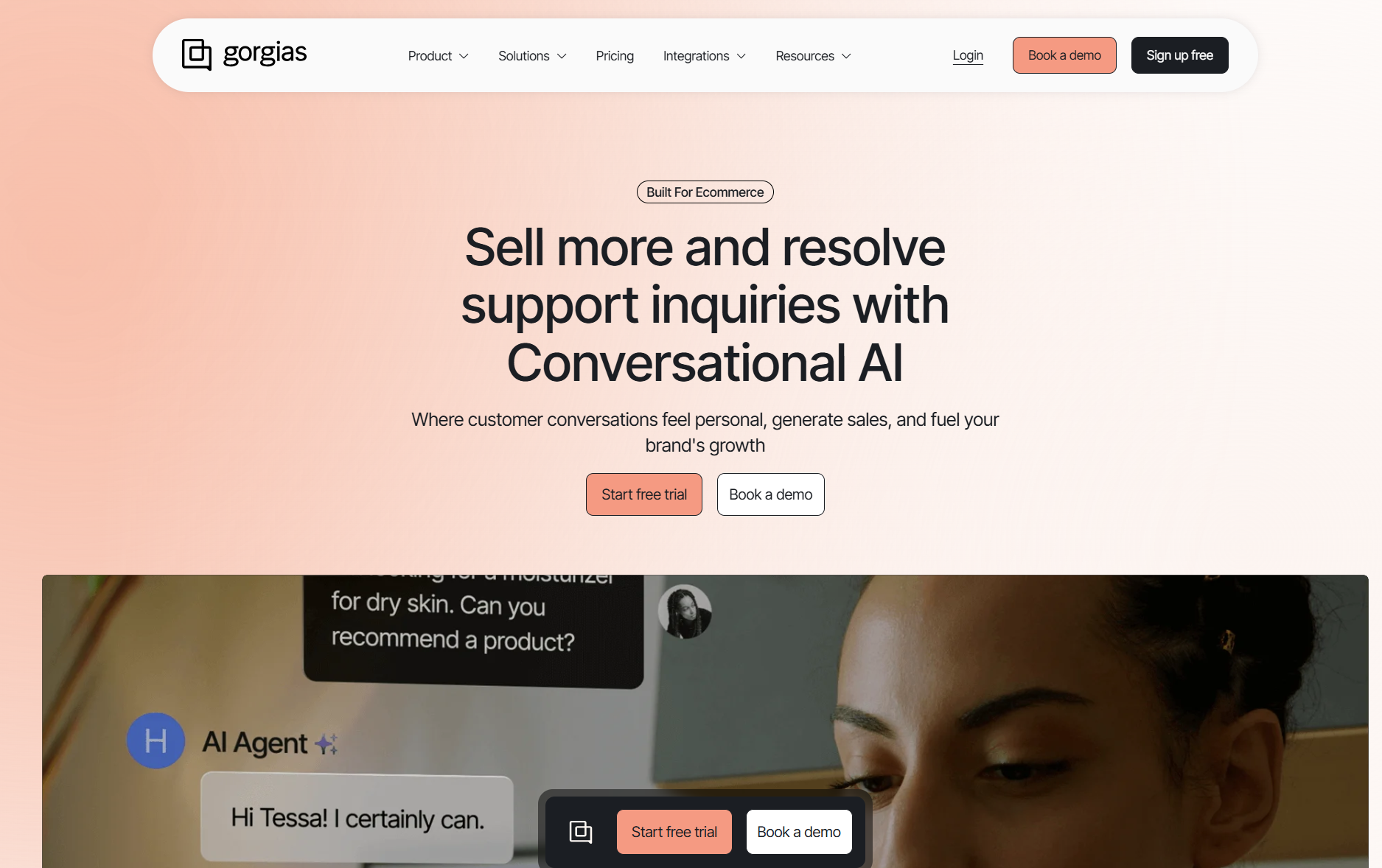
#2 — Gorgias: The Ecommerce Help Desk That Automates Support

Gorgias

Gorgias is purpose-built for ecommerce customer support, with deep integrations into Shopify, Magento, and BigCommerce. Its AI can auto-respond to common queries (order status, returns, discounts), tag tickets, and trigger actions directly inside your store admin — without the agent leaving the help desk.

  • Shopify-native: reads order data, issues refunds, edits orders directly from tickets
  • Auto-responder handles up to 60% of tickets without human involvement
  • Macros and rules engine for complex conditional routing
  • Revenue statistics: tracks support-driven conversions and upsells
💡 Best for: Shopify and BigCommerce merchants with high support volume who want a dedicated, ecommerce-aware help desk rather than a general-purpose agent.

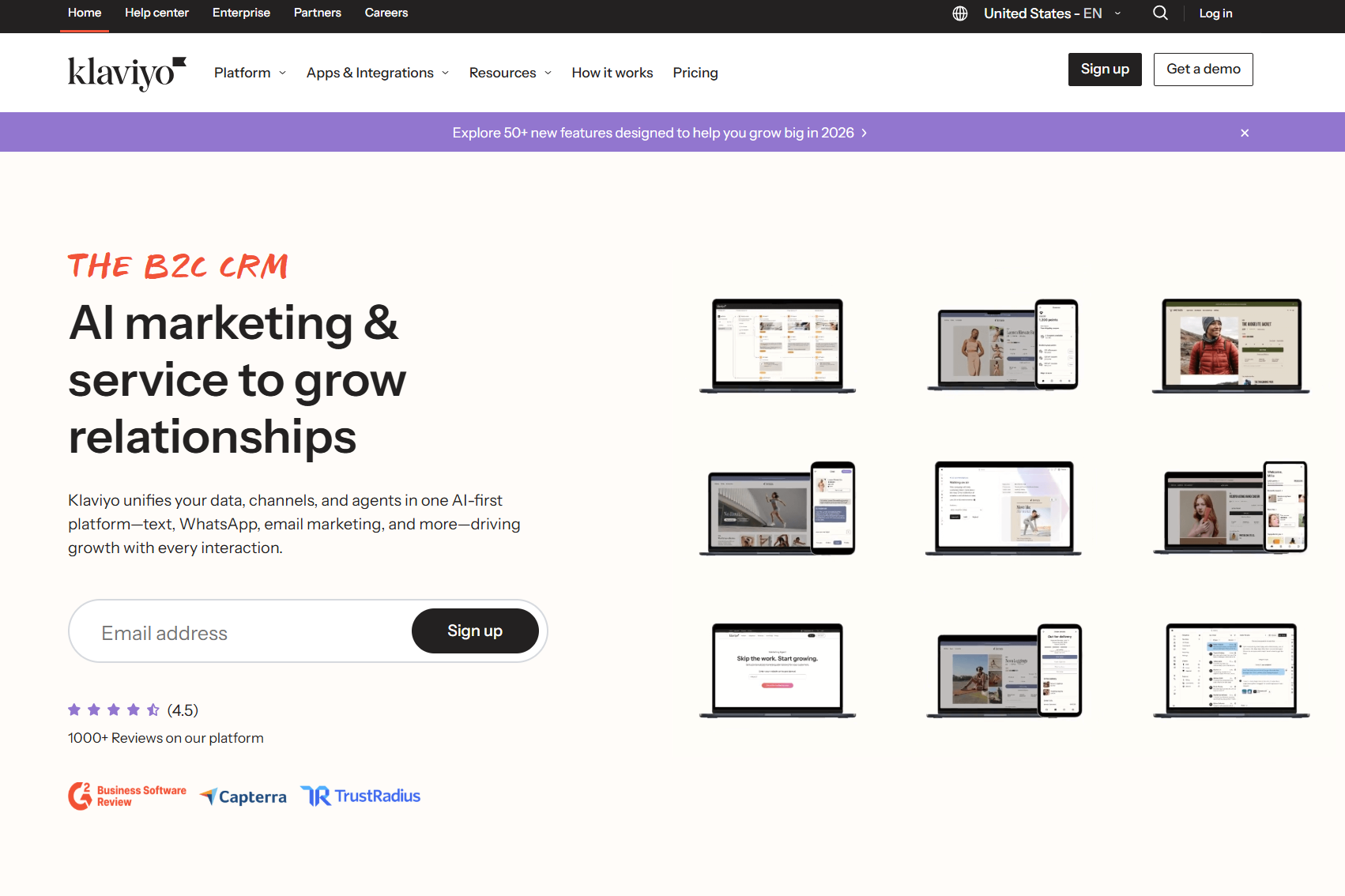
#3 — Klaviyo: AI-Powered Email & SMS Marketing Automation

Klaviyo

Klaviyo's AI layer sits on top of one of the most powerful ecommerce data platforms available. In 2026, its predictive analytics and generative AI features let merchants auto-generate personalized email flows, predict churn, identify high-LTV segments, and optimize send times — all without leaving the Klaviyo dashboard.

  • Predictive CLV, churn risk, and next-order date models built in
  • AI-generated email copy and subject line suggestions per segment
  • SMS + email unified under one customer profile
  • 300+ ecommerce integrations including Shopify, WooCommerce, and Recharge
💡 Best for: DTC brands that live and die by email/SMS performance and want AI to optimize campaigns without replacing their existing marketing stack.

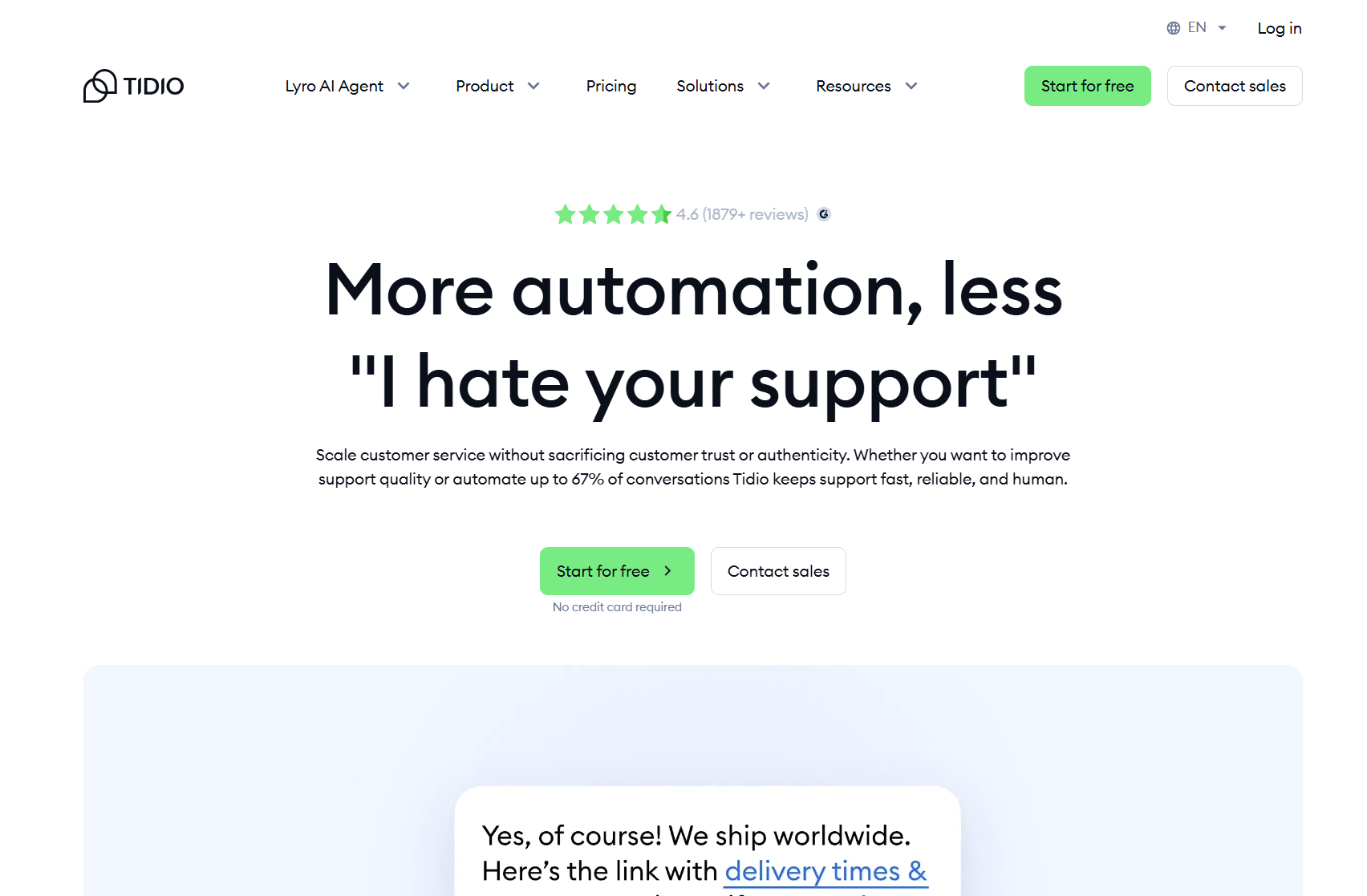
#4 — Tidio: Conversational AI for Small-to-Mid Ecommerce

Tidio

Tidio's Lyro AI chatbot handles customer inquiries using your store's knowledge base and product data, resolving up to 70% of questions without human involvement. Its live chat, chatbot, and email channels are unified in a single inbox, making it accessible for teams without dedicated support operations.

  • Lyro AI trained on your FAQs, product pages, and past conversations
  • Flows builder for visual bot creation without coding
  • Shopify and WooCommerce integrations with order lookup built in
  • Affordable pricing with a usable free tier
💡 Best for: Small ecommerce businesses and Shopify store owners who need AI-powered chat support at a price point that doesn't require an enterprise budget.

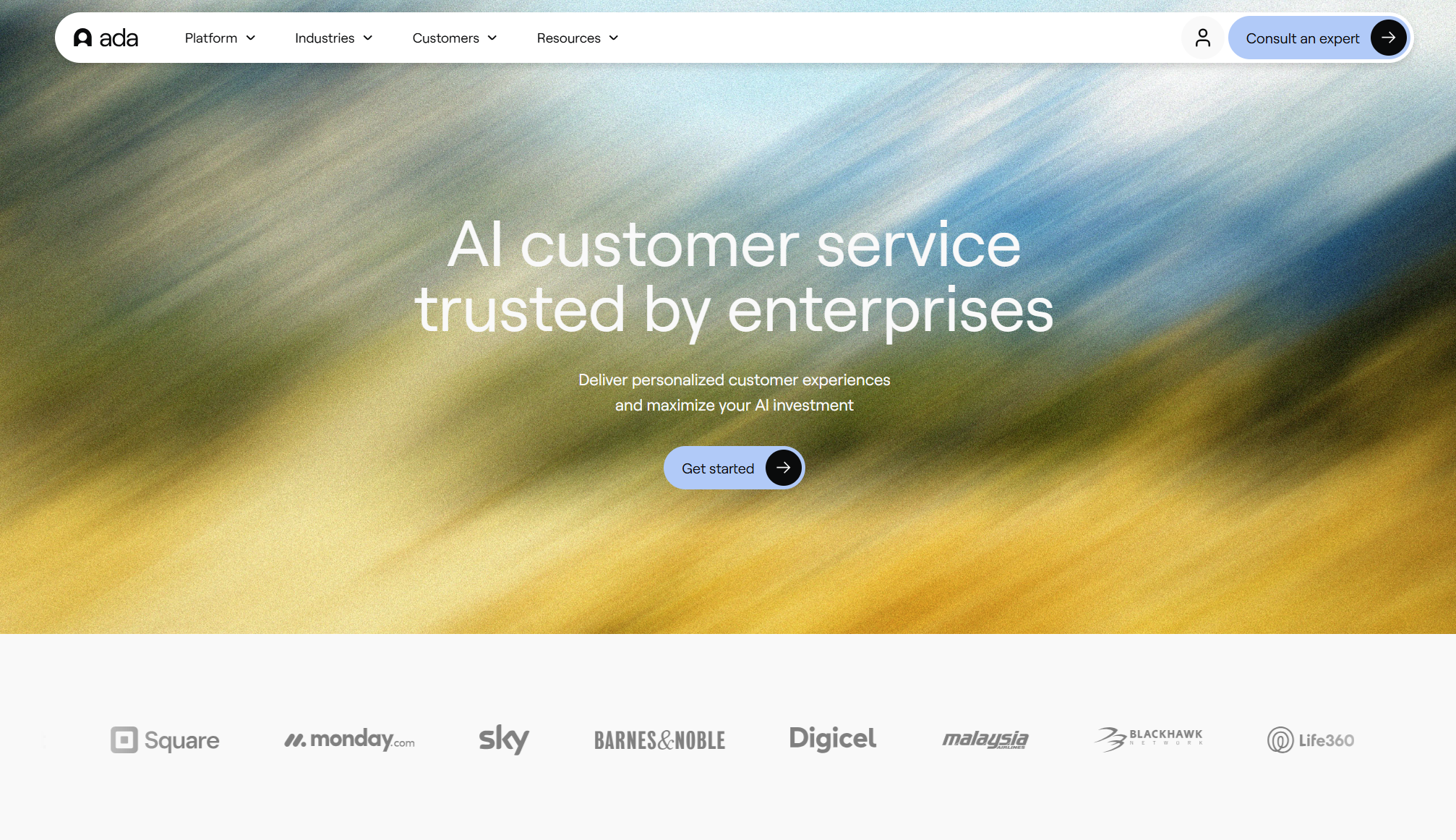
#5 — Ada: Enterprise-Grade AI Customer Service Automation

Ada

Ada is a no-code AI customer service platform designed to automate support at scale. It uses Reasoning Engine — Ada's proprietary AI layer — to interpret complex customer intents, retrieve data from connected systems, and take actions like processing refunds or updating subscriptions without human escalation.

  • Multi-channel: web, mobile, phone, and messaging apps
  • Connects to Zendesk, Salesforce, Shopify, and custom APIs
  • Conversation analytics with containment rate tracking
  • Built-in escalation to live agents with full context handoff
💡 Best for: Mid-market and enterprise ecommerce brands with high support volume across multiple channels who need a platform that scales without proportional headcount growth.

#6 — TechMonk: Full-Funnel AI for Ecommerce Growth

TechMonk

TechMonk combines AI-driven customer engagement, retention automation, and conversational commerce into a single platform. It's particularly strong in post-purchase workflows — reducing RTO (return-to-origin) rates, recovering abandoned checkouts, and running WhatsApp-native support and marketing campaigns.

  • WhatsApp Commerce: browse, order, and pay inside the chat
  • AI-powered RTO reduction through proactive post-order engagement
  • Unified customer data platform for segmentation and personalization
  • Retention automation: win-backs, reorder reminders, loyalty nudges
💡 Best for: South and Southeast Asian ecommerce brands where WhatsApp is the primary customer channel, and for merchants focused on reducing reverse logistics costs.

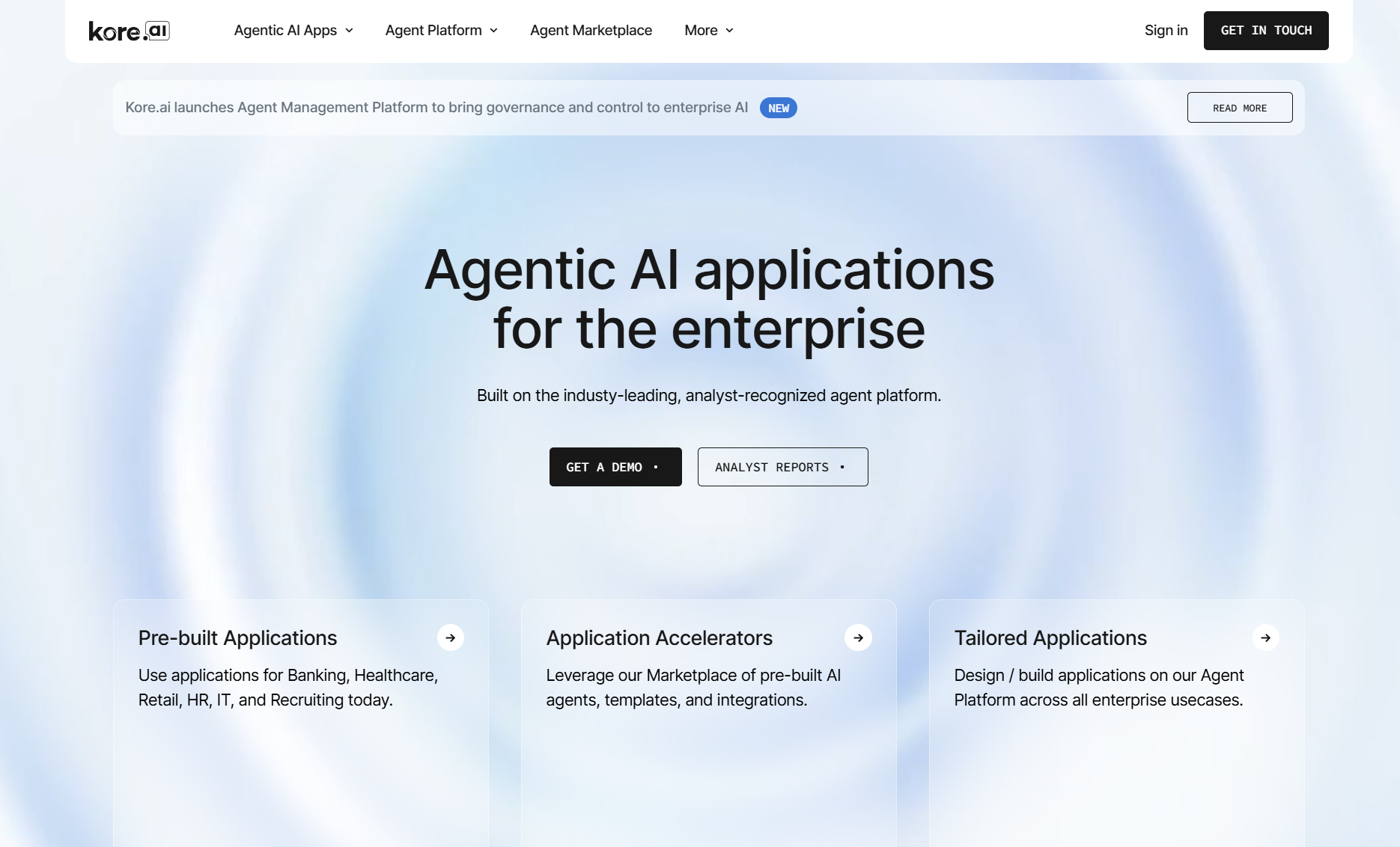
#7 — Kore.ai: Enterprise AI Agents for Commerce at Scale

Kore.ai

Kore.ai's XO Platform enables enterprises to build, deploy, and manage AI agents across customer and employee journeys. For ecommerce, this means deployable agents for customer support, order management, supply chain queries, and internal operations — all governed through a central orchestration layer.

  • No-code + pro-code agent builder with pre-built ecommerce templates
  • Supports voice, chat, and email channels out of the box
  • Enterprise security: SOC 2, GDPR, HIPAA compliance options
  • Agent orchestration: route tasks between specialized AI agents automatically
💡 Best for: Large ecommerce enterprises and omnichannel retailers that need to deploy multiple specialized AI agents across both customer-facing and internal operations.

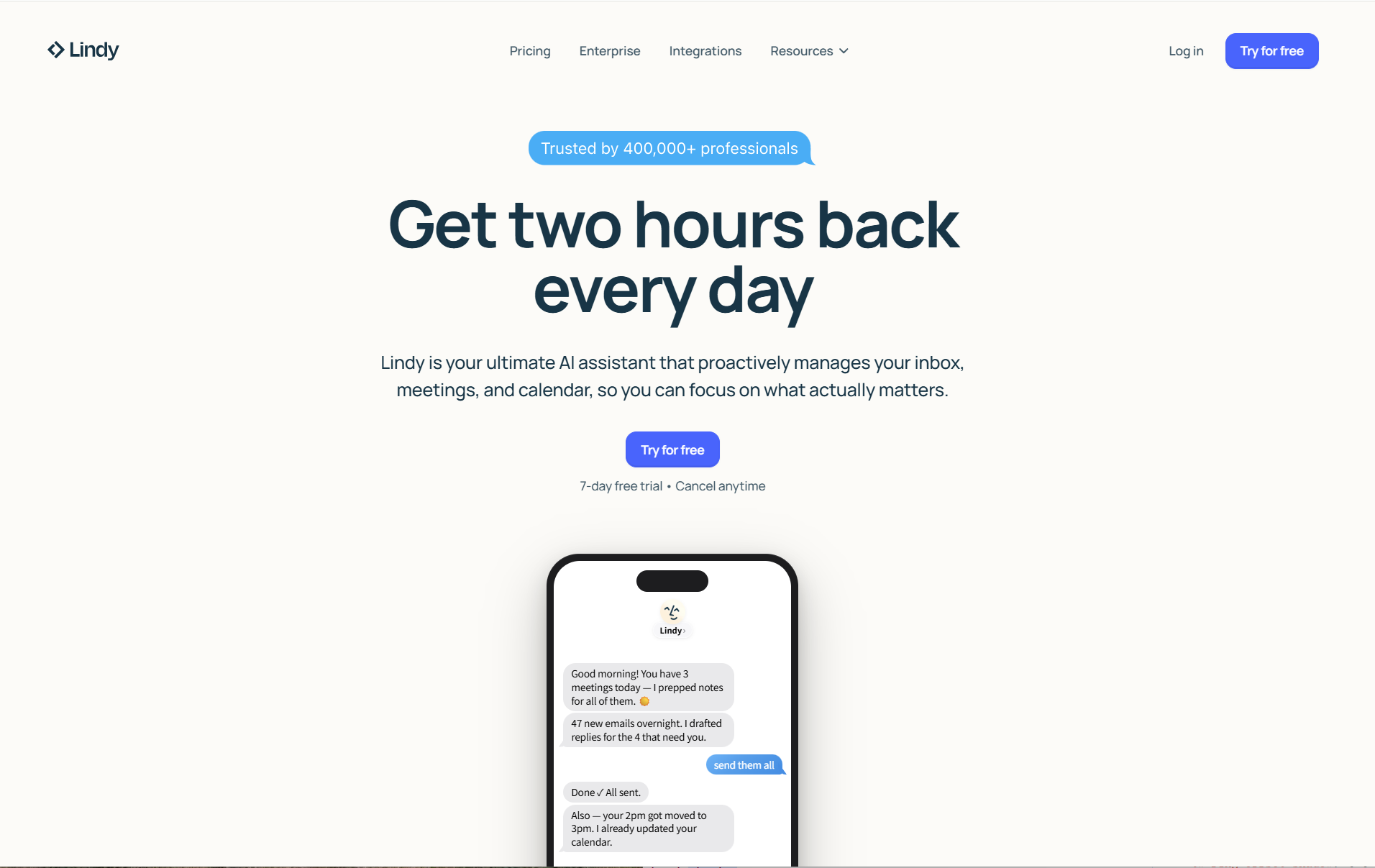
#8 — Lindy: No-Code AI Agent Builder with Ecommerce Workflows

Lindy

Lindy lets non-technical users build AI agents through a visual, no-code interface. Ecommerce applications include automated email triage and response, meeting scheduling, CRM data entry, and custom support workflows — all triggered by natural-language instructions or external events.

  • 1,000+ pre-built integrations including Gmail, Slack, HubSpot, and Shopify
  • Society of Lindies: chain multiple AI agents to handle complex workflows
  • Natural-language agent creation — describe what you want, Lindy builds it
  • Memory across interactions for personalized customer experiences
💡 Best for: Ecommerce operators and founders who want to build custom AI workflows without engineering resources, and whose stack consists primarily of API-connected SaaS tools.

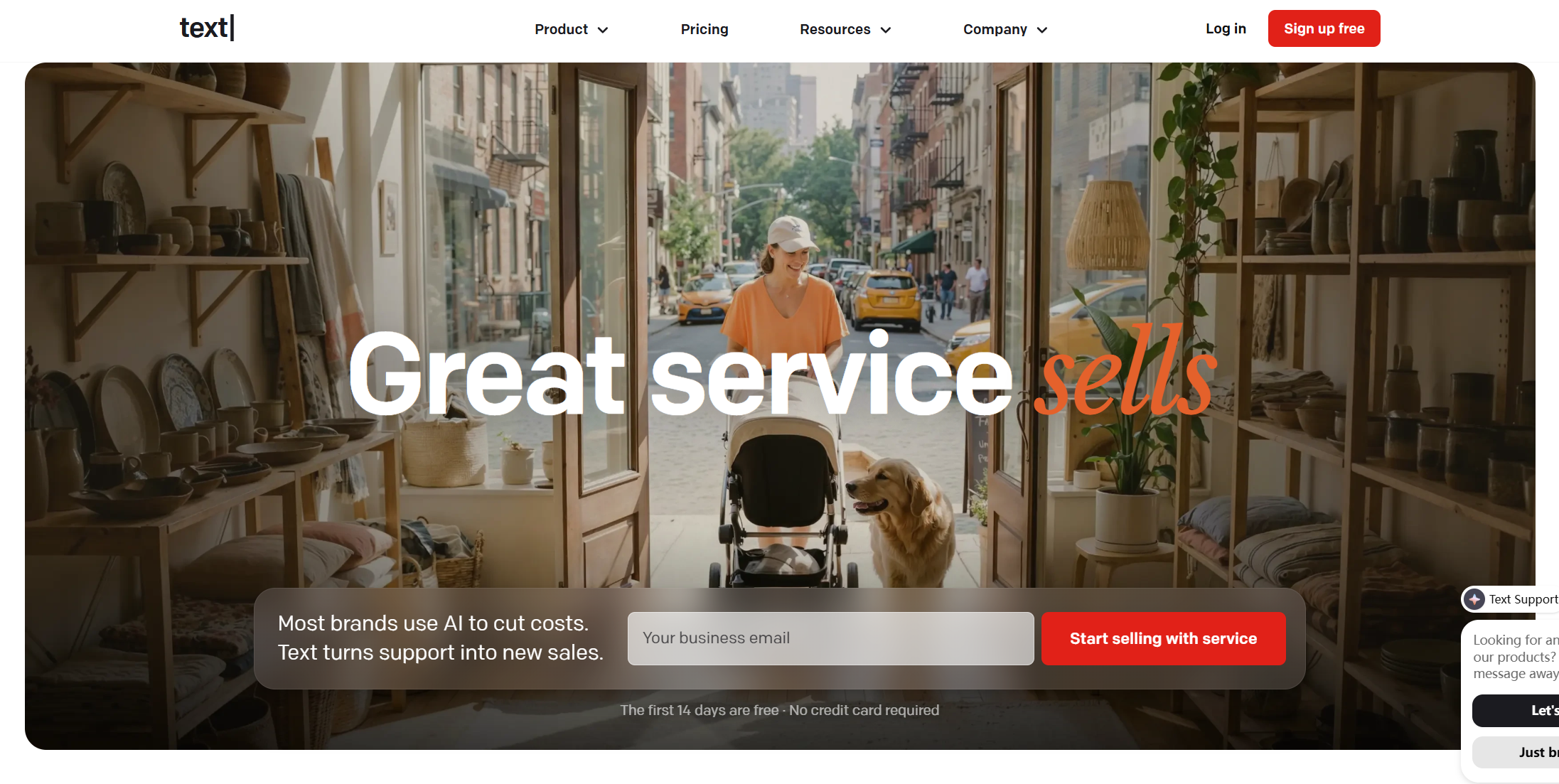
#9 — Text (formerly LiveChat): AI-Enhanced Customer Engagement Platform

Text App

Text.com is the parent platform behind LiveChat, ChatBot, and HelpDesk — combining them into a unified communication ecosystem with an AI layer that routes, responds to, and escalates customer interactions across channels. For ecommerce, it offers a polished live chat experience enriched with AI-suggested responses and automated ticket handling.

  • Unified inbox across live chat, email, and social channels
  • AI-suggested replies based on conversation context and past tickets
  • ChatBot integration for 24/7 automated first-response
  • Ecommerce-specific templates for cart recovery and product recommendations
💡 Best for: Ecommerce businesses already using LiveChat that want to layer in AI capabilities without migrating to a new platform or retraining their support team.

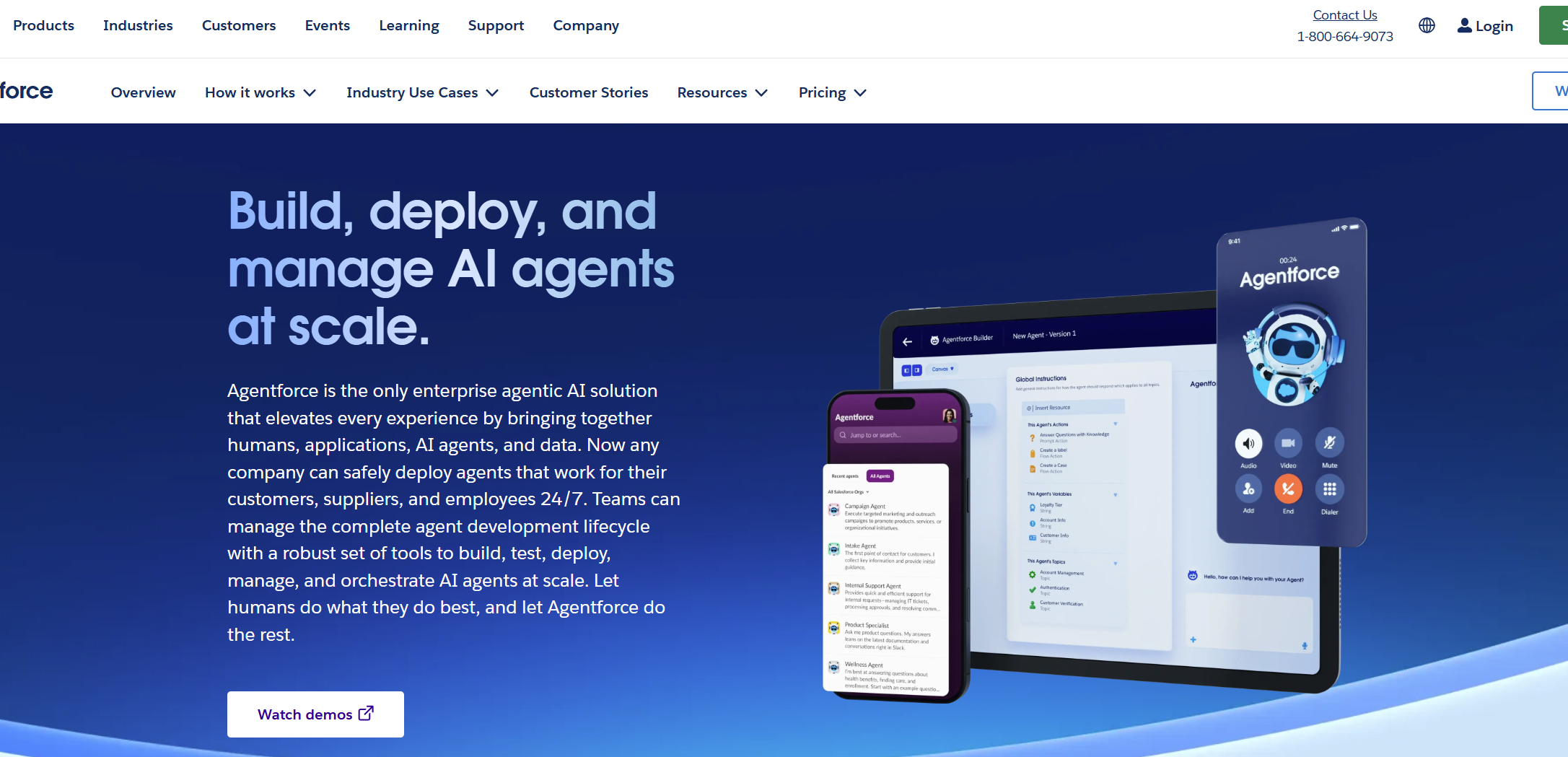
#10 — Agentforce (Salesforce): AI Agents Inside the World's Largest CRM

Agentforce (Salesforce)

Agentforce is Salesforce's AI agent layer embedded across its entire cloud — Sales Cloud, Service Cloud, Commerce Cloud, and Marketing Cloud. For enterprise ecommerce brands already on Salesforce, it unlocks autonomous agents for case resolution, order management, campaign personalization, and sales outreach — all governed within the Einstein AI framework.

  • Pre-built agents for service, sales, commerce, and field operations
  • Grounded in your Salesforce data — no external data wrangling required
  • Agent Builder: customize agent behavior with point-and-click configuration
  • Trust Layer: built-in guardrails, audit trails, and data masking
💡 Best for: Enterprise ecommerce and B2B commerce brands already invested in the Salesforce ecosystem who want AI agents that natively understand their Salesforce data model.

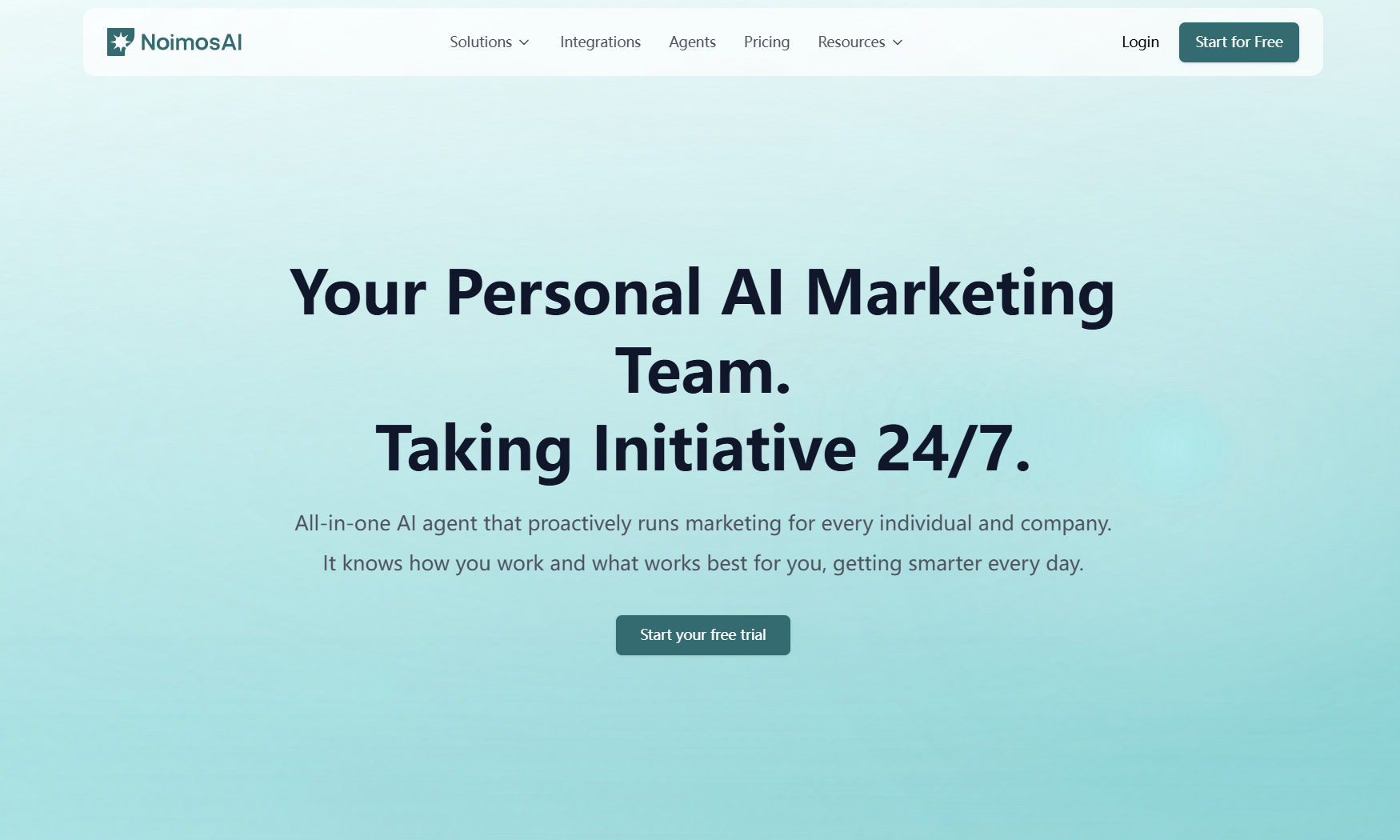
Honorable Mention — NoimosAI: Autonomous AI Agents for Ecommerce Operations

NoimosAI

NoimosAI is an emerging autonomous agent platform with a strong focus on ecommerce operations — inventory management, supplier communication, and demand forecasting. Its agent-first architecture makes it worth watching as the platform matures through 2026.

Quick Comparison: All 10 Ecommerce Agent Platforms at a Glance

Use this table to quickly identify which platform aligns with your team size, tech stack, and primary use case.

PlatformBest ForKey StrengthSetup Complexity
EasyClaw
#1 Overall
Any team needing desktop-level automationWorks with any app, no API requiredZero — under 60 seconds
Gorgias
#2
Shopify / BigCommerce support teamsDeep ecommerce help desk integrationLow
Klaviyo
#3
DTC email/SMS marketersPredictive AI on rich customer dataLow
Tidio
#4
Small ecommerce, budget-consciousAffordable AI chat with free tierVery low
Ada
#5
Mid-market & enterprise supportHigh containment rate, multi-channelMedium
TechMonk
#6
WhatsApp-first markets, RTO reductionWhatsApp Commerce + retention AIMedium
Kore.ai
#7
Enterprise omnichannel operationsMulti-agent orchestration at scaleHigh
Lindy
#8
Non-technical operators, SaaS stacksNo-code agent builder, 1,000+ integrationsLow
Text App
#9
LiveChat upgradersUnified chat + helpdesk ecosystemLow
Agentforce
#10
Salesforce enterprise customersNative Salesforce data + Trust LayerHigh

Most ecommerce teams don't need the most complex platform — they need the one that removes the most friction from their specific workflow. If you're unsure where to start, the selection guide below will help you narrow it down.

How to Evaluate an Ecommerce Agent Platform: 5 Key Criteria

Most teams get burned by choosing a platform based on demo impressions rather than operational fit. Before signing any contract, stress-test each platform against these five criteria.

Criterion 1: Scope of Automation — What Can It Actually Touch?

The most important question is not "what can this AI do?" but "what systems can it access?" Cloud-only platforms are limited to their API integrations. If your ecommerce stack includes a desktop-based ERP, a legacy warehouse management system, or any app without a published API, only a desktop-native agent like EasyClaw can automate those workflows.

  • Map every tool in your stack before evaluating platforms
  • Identify which tools have no API — those are your biggest automation gaps
  • Verify that the platform can read and write data in your specific CMS or order management system

Criterion 2: Setup & Time-to-Value

Enterprise platforms like Kore.ai and Agentforce can take weeks or months to configure. If your team needs results in days, prioritize platforms with pre-built ecommerce templates and zero-setup installation.

💡 Quick test: Ask each vendor how long it takes from account creation to your first automated workflow running in production. The answer tells you everything about where they sit on the complexity spectrum.

Criterion 3: Privacy & Data Governance

Ecommerce businesses handle sensitive customer data — PII, payment details, order history. Cloud-processed AI platforms transmit this data to external servers for every interaction. EasyClaw's local-execution model keeps all automation on your machine, with no data retained by the platform.

Criterion 4: Channel Coverage

Your customers contact you across multiple channels — web chat, email, SMS, WhatsApp, social DMs. Evaluate whether the platform handles all your active channels natively or requires additional connectors and licensing for each.

Criterion 5: Human Escalation & Agent Collaboration

No AI agent handles 100% of cases correctly. Evaluate the quality of the escalation path — does the agent hand off with full conversation context? Can human agents override or correct AI decisions? The best platforms make the human-AI collaboration seamless, not an afterthought.

🎯 The EasyClaw Advantage Most ecommerce AI platforms operate inside a single SaaS interface. EasyClaw works across your entire desktop — it can pull an order from your Shopify admin, update a row in your inventory spreadsheet, send a Slack message to your fulfillment team, and log the action in your CRM, all from a single natural-language command. No API. No integration required. No data leaving your machine.

10 Ecommerce Workflows You Can Automate with AI Agents Today

AI agents aren't limited to customer chat. Here are ten high-impact ecommerce workflows where agent automation delivers measurable time and cost savings in 2026:

🎫

Support Ticket Resolution

Auto-resolve order status, return, and refund requests end-to-end without human involvement.

🛒

Abandoned Cart Recovery

Trigger personalized multi-channel recovery sequences the moment a cart is abandoned.

📦

Inventory Management

Monitor stock levels, trigger reorder alerts, and update listings across platforms automatically.

📧

Post-Purchase Email Flows

Generate and send personalized post-purchase sequences based on order data and customer history.

💬

WhatsApp Commerce

Let customers browse products, place orders, and track shipments entirely within WhatsApp.

🔄

Returns & Refunds Processing

Automate the full returns workflow — label generation, refund issuance, and inventory update.

📊

Sales & Revenue Reporting

Pull data from multiple sources and generate daily performance reports without manual exports.

🎯

Customer Segmentation

AI continuously updates segments based on purchase behavior, engagement, and predicted LTV.

Review Request Automation

Automatically request reviews at the optimal post-delivery moment to maximize response rates.

🏭

Supplier & Vendor Communication

Draft and send purchase orders, follow up on deliveries, and log responses — all autonomously.

5 Common Mistakes When Choosing an Ecommerce Agent Platform

Most ecommerce teams don't fail at AI adoption because of technology — they fail because of selection errors that compound over time. Avoid these five.

Mistake 1: Choosing Based on Integrations Listed, Not Integrations Tested

Every platform claims hundreds of integrations. The reality is that many are shallow, one-directional data pulls with no write capability. Before committing, test the exact integration you need with your exact data structure. A platform that "integrates with Shopify" but can't issue refunds from within its interface is not solving your problem.

Mistake 2: Underestimating Setup Complexity for Enterprise Platforms

Enterprise platforms like Kore.ai and Agentforce are genuinely powerful — but their implementation timelines and required technical resources are frequently underestimated. If you don't have a dedicated implementation team, budget 3–6 months before you see production-level results. Factor this into your total cost of ownership comparison.

Mistake 3: Ignoring the Desktop Automation Gap

The biggest blind spot in most ecommerce AI evaluations is the desktop layer. If any part of your operations runs through a desktop app — a Windows-based ERP, a local accounting tool, a proprietary WMS — cloud-only platforms cannot automate it. This gap silently limits your ROI. EasyClaw is the only platform in this guide that closes it natively.

Mistake 4: Treating AI Agents as a Support-Only Tool

Most teams deploy AI agents exclusively for customer support, leaving high-value applications in marketing, operations, and logistics untouched. The platforms with the highest ROI in 2026 are those deployed across the full ecommerce operation — not just the help desk queue.

Mistake 5: Neglecting Privacy and Data Handling

Sending customer PII through third-party cloud AI systems creates regulatory exposure — especially for businesses operating in GDPR or CCPA jurisdictions. Always audit where customer data goes during AI processing, how long it's retained, and who has access. Platforms that run locally, like EasyClaw, eliminate this risk entirely.

🎯 The EasyClaw Difference EasyClaw sidesteps Mistakes 3 and 5 by design. Because it operates at the desktop level with local execution, it automates any app without an API requirement — and customer data never leaves your machine. For ecommerce teams with mixed tech stacks and privacy obligations, this is not a nice-to-have. It's a fundamental architecture advantage.

Why EasyClaw Is the Smarter Choice for Ecommerce Automation

Every other platform on this list operates within a defined API boundary. They automate what their integrations allow — and stop there. Legacy tools, desktop applications, and proprietary systems remain untouched, forcing human operators to bridge the gaps manually.

For ecommerce teams whose operations span Shopify, local ERPs, warehouse management systems, supplier portals, and internal spreadsheets, this is not a minor inconvenience. It's the core bottleneck that keeps headcount growing in proportion to order volume.

EasyClaw is built differently.

🏆 Recommended Tool — Best Ecommerce Agent Platform 2026
The Desktop-Native AI Agent for Mac & Windows

EasyClaw is not a cloud-only AI ecommerce platform. It's a desktop-native AI agent that interacts with your operating system the way a human would — clicking, typing, reading the screen, and executing multi-step workflows across any app you have installed.

For ecommerce operations, this means you can automate workflows inside apps that have no API, no integration, and no public SDK — because EasyClaw sees and controls your screen directly, just like a human operator would.

🖥️ System-Level Control

EasyClaw works with any desktop app — CMS, ERP, local IDEs, legacy software — no API required. Most AI tools can't touch these.

📱 Remote Mobile Control

Send a command from WhatsApp, Telegram, or Slack. EasyClaw executes it on your desktop instantly — even while you're away from your desk.

🔒 Privacy-First Architecture

AI processing goes through a secure cloud connection, but all automation runs locally. Screen captures and data are never retained.

⚡ Zero Setup

No Python. No Docker. No API keys. Download, install, and you're automating workflows in under 60 seconds.

Pros
  • Works with any desktop app — no API needed
  • Zero-setup — live in under 60 seconds
  • Remote control via WhatsApp, Telegram, Slack
  • Privacy-first — local execution, no data retention
  • Free tier available — no credit card required
  • Mac & Windows native
Limitations
  • Requires desktop app installation
  • Newer platform — ecosystem still expanding

EasyClaw vs. Traditional Cloud-Based Ecommerce Agent Platforms

Here's how EasyClaw compares to the cloud-based AI platforms most ecommerce teams are evaluating in 2026:

CapabilityEasyClawGorgias / Tidio / AdaLindy / Zapier AI
Works with any desktop app✓ Yes — native system control✗ Browser/API only✗ API integrations only
Zero setup required✓ One-click install~ Sign-up + configuration✗ Complex workflow config
Privacy-first (local execution)✓ Runs locally, nothing retained✗ Cloud-processed, data stored✗ Cloud-processed
Remote control via mobile✓ WhatsApp, Telegram, Slack, more✗ No~ Limited, with setup
Works with legacy/proprietary tools✓ Any UI-based app✗ No✗ No
Free to start✓ Free tier available~ Limited free plans~ Free with heavy limits
Automates desktop ERP / WMS✓ Any desktop UI — no API needed✗ Requires API integration✗ Requires API integration

The table above makes the core difference clear: EasyClaw is the only platform that eliminates the API dependency entirely — giving ecommerce teams full automation coverage across their entire software stack, not just the portion with modern APIs.

How to Choose the Right Ecommerce Agent Platform for Your Team

The right platform depends on your team size, technical resources, and which part of your ecommerce operation you need to automate first.

Choose EasyClaw if…

  • Any part of your operations runs through a desktop app with no public API
  • You need to automate workflows across multiple tools simultaneously — including legacy software
  • Privacy and data sovereignty are non-negotiable for your business or your customers
  • You want to start automating in under 60 seconds without engineering support
  • Your team needs remote control of desktop workflows via WhatsApp, Telegram, or Slack

Choose a cloud help desk (Gorgias, Tidio, Ada) if…

  • Customer support ticket volume is your primary bottleneck
  • Your store runs entirely on Shopify, BigCommerce, or Magento with full API access
  • You want a turnkey solution with ecommerce-specific templates pre-built

Choose a workflow automation platform (Lindy, Zapier AI) if…

  • Your entire stack is API-connected SaaS tools with no desktop or legacy components
  • You want to build custom cross-app automations without coding
  • Your use cases are primarily data routing and notification workflows rather than UI-level actions
🎯 Our Recommendation For most ecommerce teams in 2026, EasyClaw delivers the best balance of power, flexibility, and privacy. It's the only platform that automates your full stack — including the desktop and legacy tools that every other AI agent can't reach — with zero setup and a free tier to get started today.

Frequently Asked Questions About Ecommerce Agent Platforms

What is the best ecommerce agent platform in 2026?
Based on overall automation depth, setup simplicity, privacy architecture, and cross-stack compatibility, EasyClaw ranks as the best ecommerce agent platform in 2026. It's the only desktop-native AI agent that can automate workflows across any app — including legacy tools and desktop software that cloud platforms cannot reach — with a free tier and zero-setup installation.
How is an AI agent platform different from a chatbot?
A chatbot responds to customer messages using predefined rules or LLM conversation. An AI agent platform goes further — it takes autonomous actions across multiple systems: issuing refunds, updating records, triggering workflows, and executing multi-step tasks without waiting for human input. Agents reason through problems; chatbots respond to inputs.
Can AI agents work with Shopify and WooCommerce?
Most platforms on this list integrate with Shopify and WooCommerce via API — including Gorgias, Klaviyo, Tidio, and Lindy. EasyClaw goes further by interacting with these platforms at the desktop level, meaning it can automate tasks inside your Shopify admin interface even if no specific API endpoint exists for that action.
Are AI agent platforms safe to use with customer data?
Safety depends on the platform's data architecture. Cloud-based platforms process customer data on external servers — creating potential exposure for GDPR and CCPA compliance. EasyClaw's local-execution model keeps all automation on your machine, with no customer data transmitted to or retained by the platform, making it the strongest privacy posture in this category.
How much does an ecommerce agent platform cost?
Pricing varies widely. Tidio and EasyClaw offer usable free tiers. Mid-tier platforms like Gorgias and Klaviyo typically range from $50–$500/month depending on usage volume. Enterprise platforms like Kore.ai, Ada, and Agentforce are custom-priced and often require annual contracts starting in the thousands per month. Always calculate total cost of ownership including implementation time, not just license fees.
Can I automate my ERP or warehouse management system with an AI agent?
Most cloud-based AI agent platforms cannot automate desktop ERPs or proprietary warehouse management systems because they rely on API integrations that these tools don't provide. EasyClaw is the exception — it operates at the UI level, interacting with any desktop application the same way a human operator would, making it the only platform in this guide capable of automating legacy and desktop-based operations tools.
What ecommerce workflows benefit most from AI agent automation?
The highest-ROI applications in 2026 are: end-to-end support ticket resolution (including refund processing), abandoned cart recovery, post-purchase email and SMS flows, inventory monitoring and reorder alerts, and supplier communication. EasyClaw's desktop-level access also makes it uniquely suited for automating internal operations workflows that involve multiple tools, spreadsheets, and desktop applications.

Final Thoughts: Ecommerce Agent Platforms in 2026

The ecommerce AI agent category has matured rapidly. What started as rule-based chatbots handling order status queries has evolved into autonomous platforms capable of running end-to-end business workflows across your entire tech stack — or most of it.

The critical caveat is "most of it." Cloud-only platforms — regardless of how advanced their AI models are — remain bounded by the APIs they can access. For the majority of ecommerce teams, this means significant portions of their operations remain manual: anything running through a desktop app, a legacy system, or a proprietary tool that predates the API era.

EasyClaw removes those constraints entirely. By operating at the desktop level with local execution and zero setup, it gives ecommerce teams the first AI agent that truly automates their full stack — not just the modern, API-friendly portion of it. Add remote control via WhatsApp and Telegram, a privacy-first architecture, and a free tier with no credit card required, and the case for starting with EasyClaw is straightforward.