


The five-layer Hermes Agent architecture transforms language models from response generators into reliable operators.
The Shift From Chat Responses to Operational Loops
The simplest way to understand Hermes Agent architecture is to separate response generation from task execution.
A chatbot is usually built around a single exchange. The user asks, the model answers, and the interaction ends. Even when the answer is helpful, the model has not really operated in the user's environment. It has not checked a database, opened a file, compared live results, or verified whether the output solved the actual task.
A Hermes-style agent works differently. It runs in a loop. It receives a goal, reasons about the next step, calls a tool, observes the result, updates its state, and continues. This loop is the core reason agents feel different from ordinary AI assistants. They do not merely describe work. They can participate in the work.
That distinction matters because most business workflows are not one-shot prompts. A content marketer does not need "write a blog outline" in isolation. They need keyword research, competitor review, internal link mapping, outline generation, draft creation, formatting, and quality checks. A support team does not only need "answer this customer." It needs ticket classification, order lookup, policy matching, refund eligibility checks, and escalation when the case is sensitive.
Hermes Agent architecture is built for that middle layer between human intention and software execution.
Why Agent Architecture Matters More Than the Prompt
Many teams start with prompt improvement. They rewrite instructions, add examples, adjust tone, and try to make the model "smarter." That helps, but only up to a point.
The deeper issue is usually architectural. The agent may not know what tools are available. It may call the right tool with the wrong parameters. It may forget what happened three steps ago. It may keep looping after the answer is already sufficient. It may treat every task as equally safe, even when some actions should require approval.
A useful agent needs more than a clever system prompt. It needs boundaries, memory, observability, tool design, feedback, and evaluation. Without those pieces, the agent becomes unpredictable. It can appear impressive in a demo and unreliable in production.
This is why Hermes Agent architecture should be designed as an operating system for decisions. The model is the reasoning engine, but the surrounding system decides what the model can see, what it can do, how it records progress, how it handles mistakes, and when humans must be involved.
The Core Hermes Agent Loop
At the center of the architecture is a repeated cycle: understand, plan, act, observe, revise, and finish.
The agent first interprets the user's goal. A weak agent treats the goal as a direct instruction and rushes into action. A stronger agent identifies the required outcome, the available context, the missing information, and the risk level of the task.
Then it creates a plan. This plan does not need to be a long visible essay. In fact, production agents often benefit from compact planning. The important point is that the agent must decide what sequence of actions makes sense.
After planning, the agent acts through tools. Tools may include web search, file reading, code execution, database queries, browser automation, CRM access, spreadsheet editing, email drafting, or internal APIs. The tool call is where the agent leaves pure language and touches the working environment.
The observation step is where many bad agents break. A tool result is not automatically useful. The agent must inspect it, decide whether it changed the state of the task, and choose what to do next. If the search result is outdated, the agent should search again. If the file does not contain the expected field, it should adapt. If the API returns an error, it should recover rather than hallucinate success.
The loop ends only when a completion condition is met. That condition might be a final answer, a saved draft, a completed report, a submitted form, or a handoff to a human reviewer.
The Five Architectural Layers of a Self-Improving Agent
A Hermes-style self-improving agent can be understood through five layers: interface, reasoning, tools, memory, and evaluation.
The Interface Layer
The interface layer captures the user's intent. It may be a chat window, desktop app, browser extension, Slack bot, Telegram bot, internal dashboard, or workflow trigger. This layer should not simply pass raw user text into the model. It should clarify the task type, attach available context, identify permissions, and define the output format. A good interface layer reduces ambiguity before the agent begins expensive multi-step work.
The Reasoning Layer
The reasoning layer decides what to do next. This is where the model interprets the current state and selects an action. Reasoning should be structured enough to guide behavior but not so rigid that it becomes brittle. The best reasoning layer is not the longest prompt. It is the clearest contract. It tells the agent what success looks like, what it must not do, which sources are trusted, which actions require confirmation, and how to respond when evidence is weak.
The Tool Layer
The tool layer is where the agent becomes useful. Tools are not just technical add-ons. They are part of the agent's language. If tool names are vague, parameters are confusing, or outputs are noisy, the model will make mistakes. A tool called get_data is much weaker than one called search_customer_orders_by_email. Good tool design makes the right action obvious. It also makes dangerous actions harder. For example, an email tool should separate "create draft" from "send email." A payment tool should require explicit approval before issuing a refund. In production, tool design often matters as much as model choice.
The Memory Layer
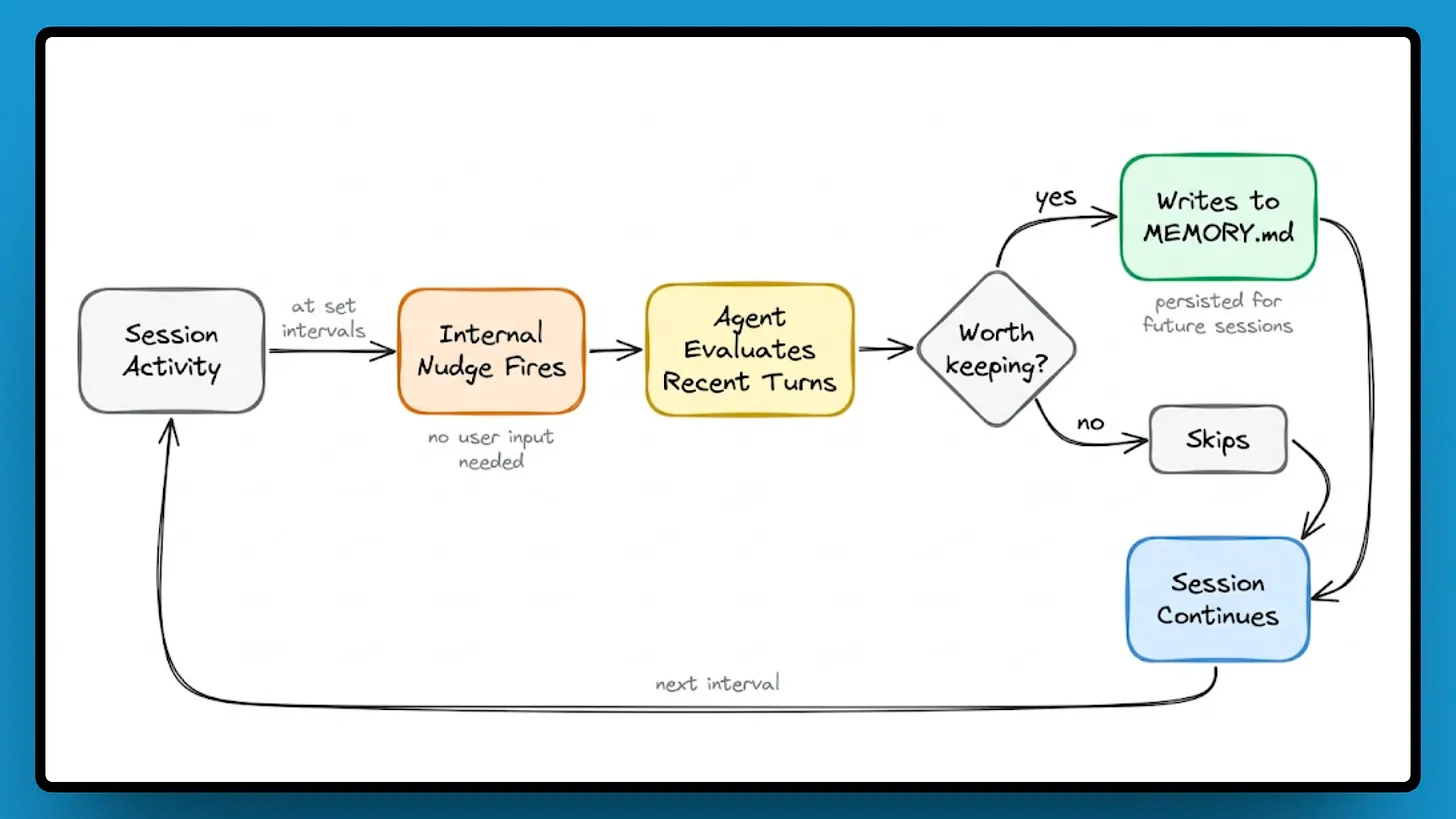
Self-improvement depends on memory, but memory is often misunderstood. An agent does not need to remember everything. In fact, remembering too much can make it worse. The memory layer should store information that improves future decisions: user preferences, recurring workflows, successful tool patterns, failed attempts, approval rules, project context, and reusable skills. There are usually several types of memory. Short-term memory tracks the current run. Long-term memory stores durable preferences and workflow knowledge. Episodic memory records past attempts and outcomes. Skill memory turns repeated procedures into reusable playbooks. The danger is stale memory. Strong architectures include memory review, expiration, user correction, and source tagging.
The Evaluation Layer
The evaluation layer is the difference between an agent that "runs" and an agent that improves. A self-improving AI agent needs feedback signals. Some feedback is automatic: Did the code pass tests? Did the API call succeed? Did the generated JSON match the schema? Other feedback is human: Did the customer support draft sound empathetic? Did the research brief include the right sources? This is how improvement becomes systematic. The team does not simply say, "The agent made a bad answer." It can identify the failure point: unclear instruction, missing context, bad tool schema, weak retrieval, unsafe memory, or poor stopping logic.
How Self-Improvement Actually Works
Self-improvement does not mean the agent magically rewrites its own neural weights after every task. In most practical systems, self-improvement happens through better context, better memory, better tools, and better evaluation loops.
Suppose an agent is used for SEO content production. At first, it may follow a generic workflow: search competitors, extract headings, draft an outline, write the article, and create metadata. After several runs, the system notices repeated corrections from editors. Maybe the drafts are too promotional. Maybe the introduction is too slow. Maybe the internal links are often irrelevant.
A self-improving architecture captures those corrections. It may update a style memory, refine the content checklist, change the evaluation rubric, or create a reusable "editor pass" skill. The model itself may be the same, but the system around it becomes more aligned with the team's standards.
This is the practical meaning of self-improving AI agents. They improve because the environment teaches them. Feedback becomes instructions. Repeated behavior becomes skills. Mistakes become test cases. Human review becomes structured memory instead of disappearing into chat history.
A Concrete Workflow: From Research Request to Finished Brief
Consider a product manager asking an agent to prepare a competitive research brief for a new productivity app.
A weak assistant might produce a generic market summary from memory. A Hermes-style agent would approach the task differently. First, it clarifies the goal: competitors, positioning, pricing, feature gaps, and user complaints. Then it searches current public sources, opens relevant pages, extracts data, and records citations. If the results are inconsistent, it performs additional checks. It may create a comparison table, identify patterns in reviews, and separate verified facts from interpretation.
Next, the agent drafts the brief. An evaluator step checks whether the brief answers the original question, whether claims are supported, and whether the recommendations are actionable. If the brief is too broad, the agent revises it. If important competitors are missing, it searches again. If the output is intended for executives, it shortens the conclusion and moves tactical details into an appendix.
The final product is not just text. It is the result of a controlled loop: research, verification, synthesis, critique, and revision.
This type of workflow shows why agent architecture matters. The value comes from the entire system, not from one impressive model response.