


The Vanity Metric of Generic Business Leads
Most legacy lead list generator platforms optimize heavily for database volume rather than timing. They hand you company sizes and job titles, then leave your sales development reps wondering why email reply rates have collapsed.
Reviews, especially historical 1-star and 2-star ratings, are fundamentally different because they capture raw frustration during an active software evaluation or renewal cycle. Demographic data only tells you that a prospect exists in the wild.
Behavioral intent tells you exactly what is broken inside their current tech stack and what the buyer is demanding to fix. When an executive complains about sudden pricing spikes, missing product integrations, or terrible customer support, they are actively looking for an exit strategy.
That is why automating unhappy customer extraction serves as the ultimate modern lead list generator upgrade. It bridges the gap between market noise and a structured stream of high-intent b2b sales leads that your outbound team can close.
The High-Intent Lead Generation Engine (Visual Logic)
Building this outbound engine requires a tightly coordinated data pipeline that moves seamlessly from discovery to direct enrichment.
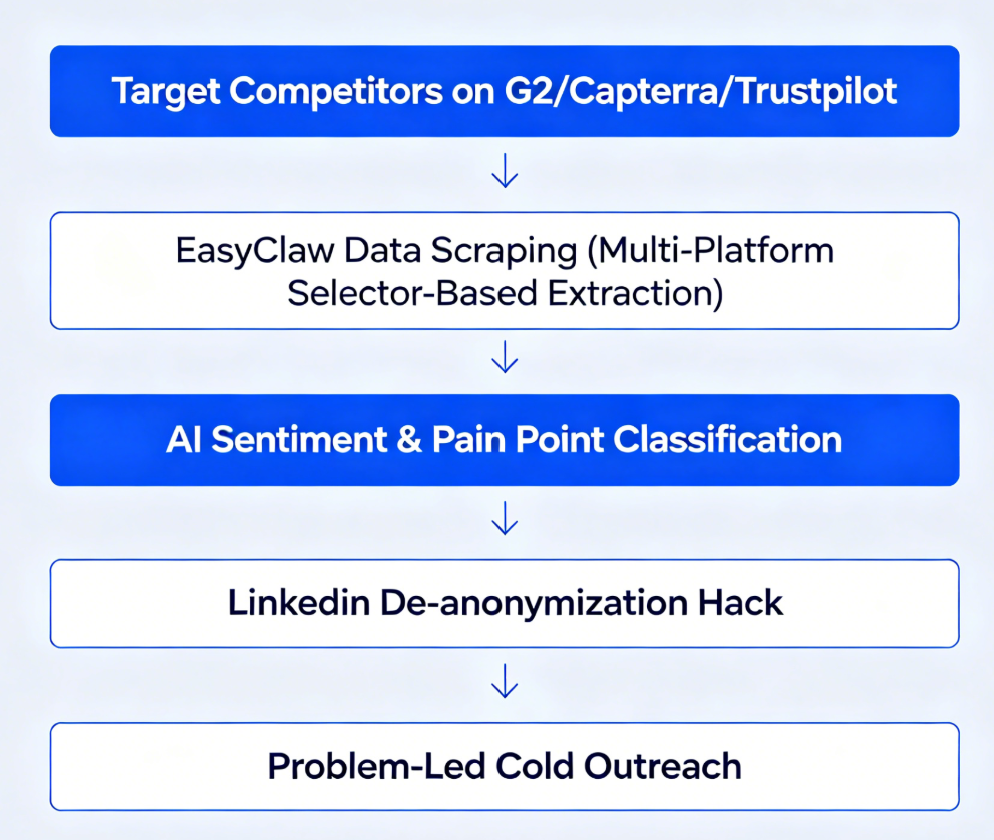
The underlying technical key is that every downstream step depends entirely on clean upstream data structures. If your scraping process returns messy or truncated text blocks, your AI layer becomes a guessing engine. When your database outputs clear variables, your targeted outreach converts at a significantly higher rate.
Step 1: Map Competitor Footprints Where Bad Feedback Clusters
You must start by mapping your direct competitors' profiles across G2, Capterra, and Trustpilot, since review patterns differ wildly by platform. You are not just counting star averages here; you are systematically locating URL sources where negative feedback repeats with predictable triggers.
Focus your initial research on review sections that contain granular discussions regarding product workflows, specific software integrations, and billing changes. On platforms like G2 and Capterra, the most actionable intent data appears inside the explicit Pros and Cons text blocks.
Once you identify which specific competitor URLs produce the highest density of negative reviews, you add them directly into your data collection queue. This ensures you spend engineering resources only on URLs that act as an active lead list generator for market frustration.
Step 2: Automate Batch Review Extraction with EasyClaw
After your target footprints are completely mapped, you can automate the extraction process using EasyClaw to ensure the system collects structured data fields on a recurring schedule. You need to capture the author's stated metadata, the raw review text, the star rating, the publication date, and any contextual company hints.
Below is a production-ready configuration JSON designed for EasyClaw's browser agent environment. It targets standard review element classes, filters out high-star noise at the source, and handles multi-page pagination safely.
{
  "name": "easyclaw_competitor_review_batch",
  "mode": "browser_agent",
  "target": {
    "startUrls": [
      "https://www.g2.com/products/COMPETITOR-REVIEWS",
      "https://www.trustpilot.com/review/COMPETITOR",
      "https://www.capterra.com/p/COMPETITOR-REVIEWS"
    ]
  },
  "scrape": {
    "items": {
      "reviewCards": {
        "selector": "div[data-testid='review-card'], article.review, div[class*='review']",
        "fields": {
          "rating": { "selector": "[data-testid='rating'], .star-rating", "type": "number" },
          "reviewText": { "selector": ".review-body, [class*='review-text']", "type": "text" },
          "prosConsText": { "selector": ".pros-cons, .pros, .cons", "type": "text", "optional": true },
          "date": { "selector": "time, .date", "type": "date" },
          "authorMeta": { "selector": ".reviewer, .author, [class*='reviewer']", "type": "text", "optional": true }
        }
      }
    },
    "filter": {
      "where": [
        { "field": "rating", "op": "<=", "value": 2 }
      ]
    },
    "pagination": {
      "strategy": "click_next_or_next_page",
      "nextSelector": "a[aria-label*='Next'], button[aria-label*='Next']",
      "maxPages": 40
    }
  },
  "output": {
    "format": "jsonl"
  },
  "antiBot": {
    "enableStealth": true,
    "humanLike": { "mouseMoves": true, "scroll": true, "jitterMs": [120, 420] }
  }
}
Running this exact script on a weekly automation loop ensures your CRM receives a steady feed of fresh data. Once EasyClaw handles the anti-bot bypass and outputs clean JSONL files, you are ready to pass the payloads into the machine learning layer.
Step 3: Run AI Sentiment Analysis to Isolate High-Intent Leads
Raw review strings must be transformed into highly structured pain categories before your sales representatives can action them. The most efficient pipeline applies an AI filter that extracts the core complaint intent, business impact severity, and specific product gaps from the narrative.
You can pass the scraped text fields directly into an LLM using a highly restrictive, schema-forced prompt block designed to eliminate hallucination.
System: You are an enterprise B2B buyer-intent classifier. Extract complaint intent from negative software reviews. Only use the provided text.
Task: Given reviewText and prosConsText, classify the complaint into this exact JSON schema:

{
  "primaryComplaintCategory": "pricing|bugs|integrations|support|usability|missingFeatures",
  "impactSummary": "Brief summary of business damage mentioned",
  "urgencySignals": ["recentMigrationIssues","renewalRisk","timeLoss","billingSurprise"],
  "buyerStage": "evaluating|migrating|renewalConcern|alreadyUsing",
  "recommendedOutreachAngle": "switchingAlternative|integrationFix"
}

User Input:
reviewText: {{reviewText}}
prosConsText: {{prosConsText}}
The resulting JSON variables allow you to automatically segment your target lists based on software vulnerability. When you know a prospect is experiencing an engineering breakdown due to a competitor's broken API, your alternative solution becomes instantly compelling.
Step 4: The De-anonymization Hack and the Perfect Pivot Outreach
Many high-value reviews on G2 are published anonymously, showing only text labels like "Verified User in Logistics, Mid-Market (51-200 employees)." You can easily crack this anonymity by treating these public parameters as a precise cryptographic key on LinkedIn.
For example, if an anonymous 2-star review complains about a broken Salesforce integration on a specific date, you can cross-reference LinkedIn for companies within that exact logistics employee band. You then filter for target personas like Head of Sales Ops who updated their profile around that review timeline.
Once the probable decision-maker is identified, your outbound messaging must pivot smoothly around the problem category without revealing your underlying data extraction mechanics. Instead of saying you tracked their review, you open your pitch by referencing widespread market frustration with that competitor's specific product flaw.
A natural message structure states that several logistics firms in the 200-employee tier have migrated to your platform this month due to ongoing Salesforce synchronization errors. This positions your product as a timely savior rather than an aggressive, uninvited sales pitch.
Generic Databases vs. Intent-Based Review Scraping
Understanding the operational differences highlights why intent data outperforms standard demographic targeting across every metric.
| Metric Category | Generic Lead Databases | Intent-Based Review Scraping |
|---|---|---|
| Data Freshness | Static (Updated quarterly or annually) | Real-time (Captured within hours of posting) |
| Buying Trigger | Inferred based on broad title/funding shifts | Explicitly stated product and support pain |
| Email Reply Rates | Low (Typically under 1-3% due to saturation) | High (Often 12-25% due to radical relevance) |
| Sales Cycle Velocity | Slow (Requires educating a cold contact) | Fast (Buyer is actively seeking a platform exit) |
| Pipeline Predictability | Unpredictable volume chasing | Consistent stream linked to competitor failures |
Transitioning away from a static lead list generator toward a dynamic web scraping workflow fundamentally changes your acquisition efficiency. It ensures your SDR team only spends energy communicating with prospects who are currently feeling the pain of an inadequate product.
Seamless EasyClaw Integration
This growth hack achieves maximum ROI when data collection, browser emulation, and proxy rotation are centralized inside a single enterprise platform. EasyClaw provides the exact scraping infrastructure required to monitor G2, Capterra, and Trustpilot concurrently without breaking under heavy anti-bot defenses.
By standardizing raw review elements into predictable schemas, EasyClaw keeps your upstream data pipeline completely stable over long periods. This constant flow of data transforms your outward motion into an evergreen intent machine that catches buyers while they are still frustrated.
Rather than executing manual data exports that quickly become outdated, you can plug these automated workflows directly into your cloud stack. You can review the pre-built review scraping templates today on the EasyClaw platform or easily request a tailored live growth engineering demo.
Conclusion & Actionable CTA
Winning the modern B2B landscape is no longer a question of finding accounts; it is a race to identify active market urgency. Relying on generic business leads without clear behavioral indicators leads to low reply metrics and predictable pipeline stagnation.
By extracting competitor negative reviews via automated workflows, running them through structured sentiment analysis, and targeting the implied personas, you generate high-converting b2b sales leads.
Let EasyClaw handle the heavy technical lifting of multi-platform web extraction and data normalization for your business. Deploy an automated review scraping workflow this week to capture your competitor's unhappiest accounts before they look anywhere else.