


If you’re still relying on scraping and “mass outreach” scripts, you’re paying for it with account risk in 2026. Platform enforcement is tighter, detection is more behavioral, and the penalty isn’t subtle anymore: shadowbans, throttled reach, limited messaging, and sudden suspensions after suspicious engagement patterns. Meanwhile, the day-to-day reality for growth teams is brutal—Facebook lead capture, TikTok attention signals, and Instagram intent cues all arrive in different places, so your pipeline becomes manual triage instead of predictable growth.
This guide shows a safe alternative: a Multi-Channel Monitoring & Automated Trigger Strategy that uses EasyClaw to monitor intent-rich keywords and hashtags across Facebook, TikTok, and Instagram in real time, extracts high-signal profiles and post context, then triggers personalized follow-ups with human-like timing and platform-aware behavior. The outcome is simple: you scale lead generation without turning your marketing account into a liability.
The Friction of Omnichannel Social Selling and Platform Silos
Meta and ByteDance have both tightened how they expose data to third parties, and they’ve also tightened what they allow automated behavior to look like. APIs are limited, scraping paths are unstable, and the platforms increasingly rely on rate limits and interaction-pattern detection. On the messaging side, DM filters are strict and conservative; prompts that resemble spam or that originate from repeatable automation patterns are treated as risky. Even when a tool “works” technically, it may still create engagement fingerprints that platforms can associate with coordinated outreach.
That’s why fragmentation hurts. If you only watch Facebook, you miss TikTok intent momentum. If you only monitor TikTok comments, your Instagram Reels leads never enter the workflow. And if you try to stitch everything together with manual copy-paste, your conversion speed collapses precisely when interest is hottest. For B2B and D2C brands, that gap is costly: leads don’t wait, and social proof decays quickly when you respond days later or not at all.
The Core Framework: A Detailed Text-Based Flowchart
Here’s the high-level workflow, expressed as a text flowchart. Think of it as intent capture first, outreach second. Outreach only triggers when there is enough context to respond naturally.
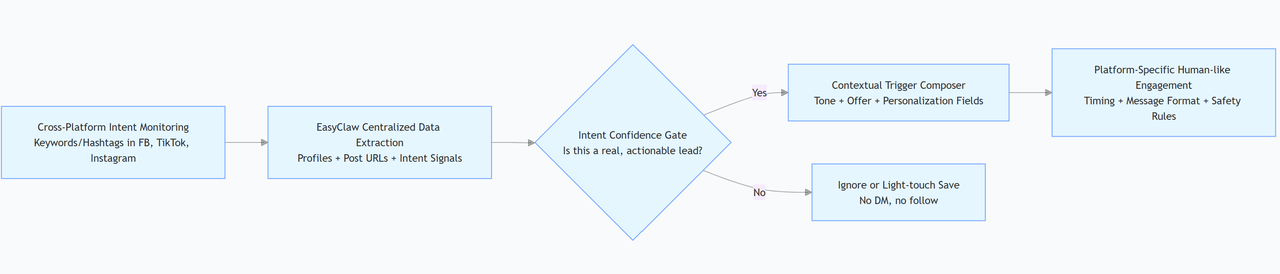
Once the intent confidence gate is passed, the process transitions smoothly into follow-up workflows that respect platform norms. Instead of blasting messages, you generate a context-aware response path and then pace it like a real account would.
Step-by-Step Implementation Guide
Step 1: Setting Up Omnichannel Intent Listening
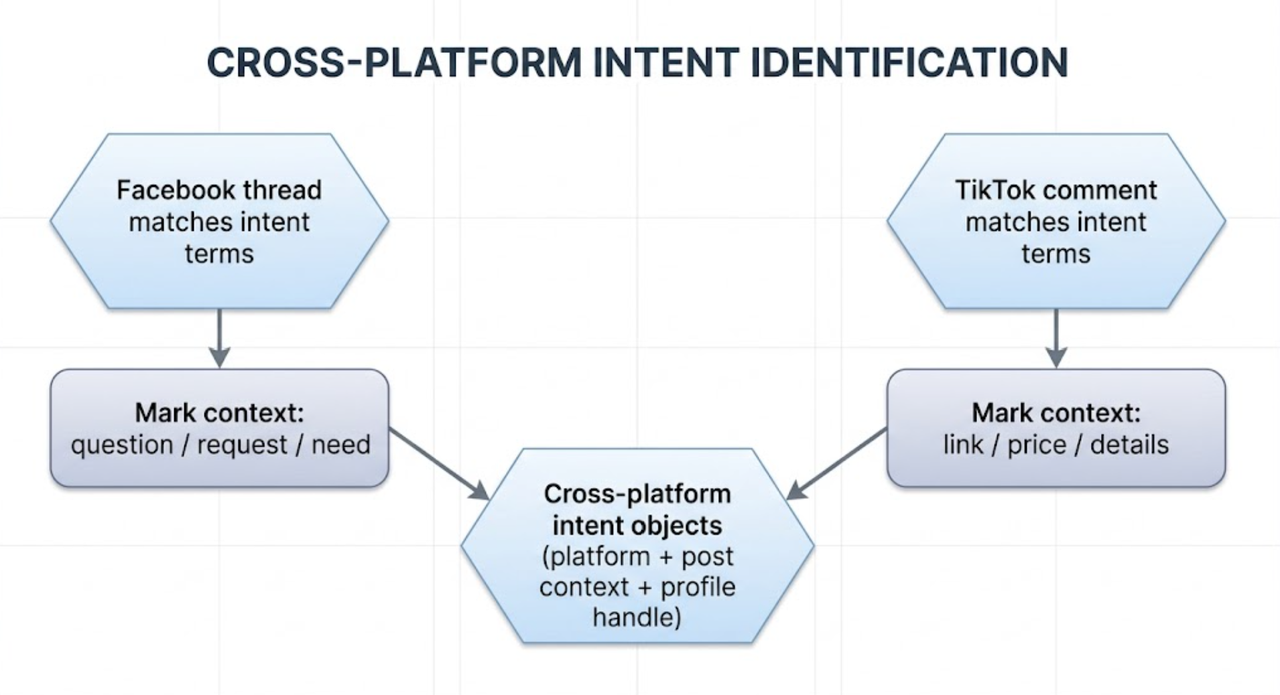
To begin this process, you first define what “hot lead” means across each platform, because “intent language” is not uniform. On Facebook, intent often shows up as questions inside group threads, comments that request recommendations, or posts that signal purchase readiness. On TikTok, it tends to appear in comment sections where users ask for links, request product details, or describe a pain point that your offer can solve. On Instagram, Reels and related comments frequently contain short, direct queries, saves, or “where can I get this?” style signals.
The operational logic here is straightforward: you listen to intent-rich keywords and hashtags rather than generic brand terms. Brand terms can attract existing followers, but they don’t always capture buying intent. Intent terms catch people at the moment they’re actively asking for help Bowen. When you configure listening, you set the scope so you’re not drowning in noise. That means choosing a tight set of keywords and hashtags that represent a clear desire category. It also means applying platform-specific variations, because the same concept is phrased differently on each app.
As this monitoring runs, the system tags every match with the originating platform and the context it came from, such as the post type and whether the user expressed a question, an interest statement, or a request for a next step. Instead of treating all signals equally, you create a consistent internal representation of “intent” so later steps can reliably trigger safe engagement.
Step 2: Centralized Data Extraction via EasyClaw Browser Agents
Once intent objects are detected, the next phase transitions smoothly into centralized data extraction. Instead of relying on fragile scraping tricks, EasyClaw uses browser agents to observe and capture the profile context you need to respond accurately. The critical operational point is this: extraction is used to build a safe and relevant follow-up, not to bypass platform rules.
In practice, EasyClaw collects intent signals and the minimum set of profile and post context required for personalization. That typically includes the profile identity the user is interacting from, the specific post URL where the intent was expressed, and the text signals that caused the trigger in the first place. Because the goal is safe engagement, you avoid collecting or reusing data you shouldn’t. You also avoid turning the tool into a bulk data harvester. The process is oriented around “respondability”: can you write a message that fits the exact context without generic copy?
To reduce account risk, the extraction workflow is paced and contextual. It does not behave like a bot farm. It watches what a human would naturally look at when they’re deciding whether to reply. That matters because platforms detect automated patterns at the behavioral layer, not just the data layer.
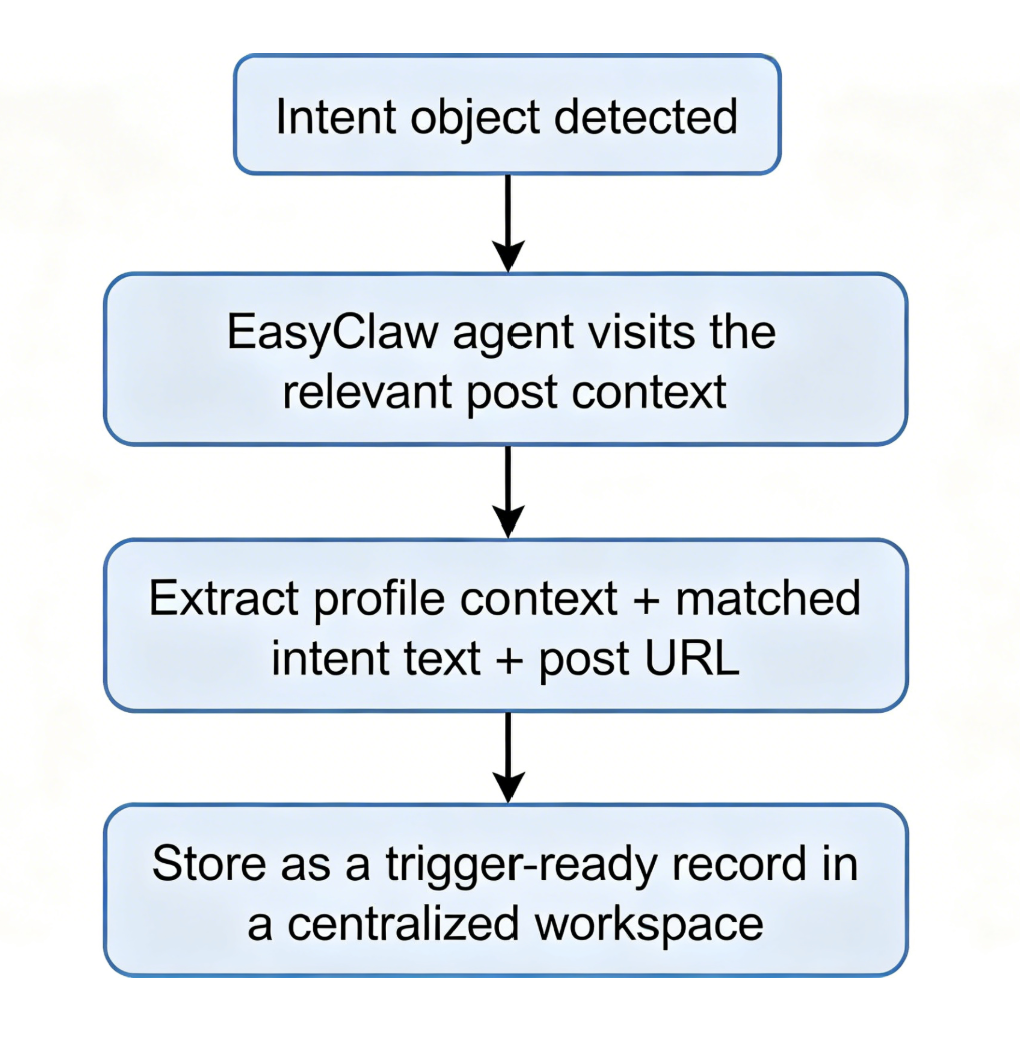
This is where your omnichannel pipeline stops being fragmented. Facebook, TikTok, and Instagram leads land in the same operational lane, with consistent “trigger-ready” context.
Step 3: Executing Platform-Specific Automated DM and Follow-Up Workflows
After extraction, you don’t immediately message everyone. Instead, you run an intent confidence gate, because safe automation requires selectivity. A user who drops a vague brand emoji isn’t the same as a user asking for product availability or requesting a link. The gate is where you translate raw monitoring into actionable lead generation.
Once a record passes, the next step is platform-specific DM and follow-up. This is not just tone variation; it’s behavior design. TikTok comment-to-DM flows often require a different cadence than Instagram Reels comment replies, and Facebook group discussions often reward clarity and relevance over speed. Your messaging should look like it belongs to the platform’s conversational style, not like a template that got pasted everywhere.
Timing is central. To keep the workflow safe and realistic, you schedule outreach with human-like intervals. You also avoid patterns that suggest a mass-send wave. Instead, you distribute follow-ups over time and only escalate when the lead’s context supports it. Personalization fields are also not optional. The message should reference the user’s intent signal, not just the fact that “they engaged.” When you answer the question they asked, you reduce the chance that your outreach is treated as spam, because the interaction becomes genuinely helpful.
Once the DM is sent, you monitor outcomes and decide whether to follow up. If the user doesn’t engage back, you don’t keep hammering. If they do, you transition from trigger messaging into a more complete conversation. This is how you maintain account safety while still moving fast enough to win.
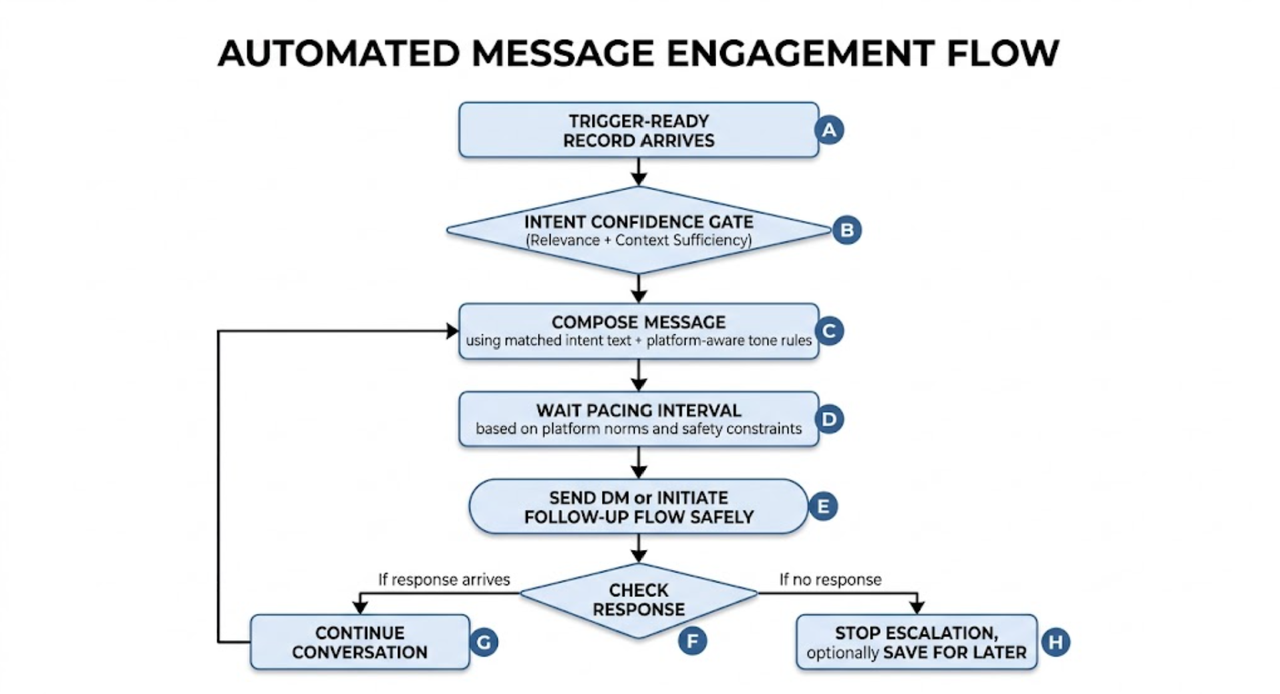
This is the heart of the hybrid approach. Monitoring is automated across channels. Engagement is contextual, personalized, and paced as if a human team member is managing it.
Manual Multi-Platform Grinding vs. EasyClaw Automated Hybrid Strategy
The reason this comparison matters for pipeline performance is simple: you can’t scale “responding” if you can’t scale “detecting intent.”
| Capability / Metric | Manual Multi-Platform Grinding | EasyClaw Automated Hybrid Strategy |
|---|---|---|
| Monitoring Coverage | Intermittent, single-platform focus; delayed detection. | Continuous cross-platform observation (FB, TikTok, IG). |
| Data Extraction | Manual copy-paste or risky, brittle scraping tools. | Context-aware via local browser agents. |
| Lead Triage & Speed | Slow triage; response gap allows leads to cool down. | Instant intent tagging and ready-to-trigger status. |
| Outreach Delivery | Irregular bulk blasts or tedious manual typing. | Paced, platform-specific human-like engagement. |
| Account Risk Level | High risk of footprinting or manual fatigue errors. | Low risk via behavioral distribution and strict filters. |
| Personalization Depth | Highly variable; shortcuts lead to generic templates. | High; maps responses directly to verified intent context. |
Seamless EasyClaw Integration
EasyClaw is the engine that ties this together. It centralizes cross-platform monitoring, records intent-rich profiles and post context, and enables safe trigger-based engagement without falling into aggressive scraping or mass-DM behaviors that lead to account penalties. The system is built for hybrid execution: automate the detection and extraction, then trigger human-like follow-ups that respect platform boundaries.
If you want to validate the blueprint for your exact offer, keyword/hashtag intent categories, and response style, the next step is simple. Request a custom multi-channel workflow demo so we can map your current messaging flow into an EasyClaw monitoring and trigger design tailored to Facebook lead generation, tiktok lead generation, and Instagram Reels-based intent capture.
Conclusion and Actionable CTA
Traditional omnichannel social selling often turns into fragmented chaos: separate monitoring, separate notes, separate inboxes, and separate follow-up timing. Worse, teams that try to “fix speed” with aggressive scraping or bulk outreach discover the hard truth—platform safeguards punish predictable automation patterns, not just bad intentions.
This blueprint shifts the model from chasing leads to capturing intent and acting safely. With EasyClaw, you monitor high-intent keywords and hashtags across Facebook, TikTok, and Instagram, extract context needed for relevant personalization, then trigger platform-specific follow-up workflows with pacing and tone designed to look human. That’s how you scale social media lead generation without turning compliance into guesswork.
If you’re ready to move from manual grind to centralized automation, try EasyClaw or request a custom multi-channel workflow demo. We’ll help you design an omnichannel monitoring blueprint that fits your brand voice, your safety constraints, and your pipeline goals.